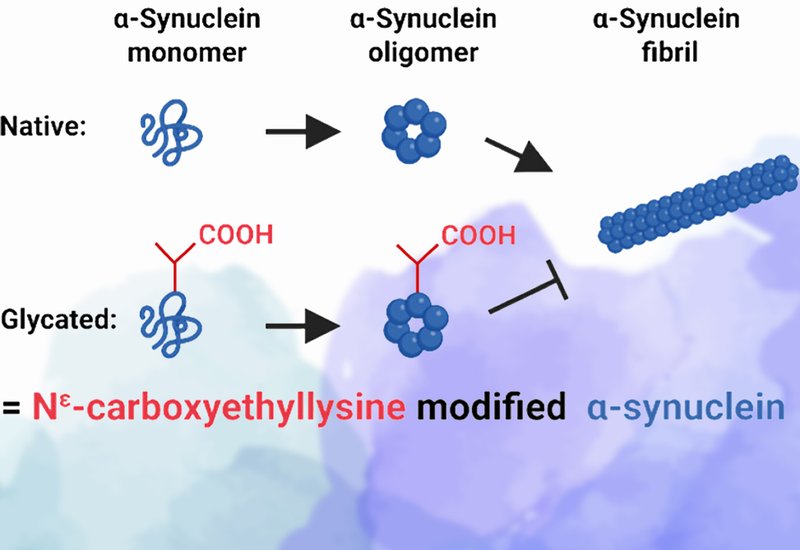
α-Synuclein, αSyn, aggregation drives the progressive neurodegeneration of Parkinson's disease, and non-enzymatic post-translational modifications that accumulate during aging and metabolic stress are implicated in shaping that process. Among these modifications, glycation by methylglyoxal, MGO, stands out: MGO levels rise in type 2 diabetes, a condition linked to 1.1- to 2.8-fold increased Parkinson's disease risk, and the advanced glycation endproduct Nε-carboxyethyllysine, CEL, accumulates preferentially in the lysine-rich N-terminal region of αSyn and is enriched in patient brain tissue. Previous studies established that bulk MGO treatment impairs vesicle binding and inhibits fibrillization, but global modification produces heterogeneous protein populations carrying variable numbers of CEL marks at multiple sites, making mechanistic interpretation unreliable.
Researchers in the Baldensperger and Becker Groups at the University of Vienna, published in ACS Chemical Biology, developed two complementary semisynthetic strategies based on native chemical ligation, NCL, to place single CEL modifications at eleven defined positions across the N-terminal region of αSyn. For residues 6, 10, 12, 21, and 23, a two-segment approach ligated a synthetic αSyn 1–29 peptide hydrazide thioester carrying the CEL building block to a recombinantly expressed αSyn 30–140 A30C fragment, followed by radical-mediated desulfurization. For the more central positions 32, 34, 43, 45, 58, and 60, a three-segment strategy added an Acm-protected synthetic middle segment and a His6-SUMO-tagged C-terminal fragment expressed in E. coli. Combined ligation and desulfurization yields reached 48–55% for the two-segment route and 19–25% for the three-segment route, producing 10–20 mg of each homogeneously modified variant.
Circular dichroism spectroscopy confirmed that all eleven CEL-modified αSyn variants retained the characteristic intrinsically disordered random-coil signature of wild-type αSyn in solution. Upon addition of anionic dioleoylphosphatidylserine liposomes at a 10-fold molar excess, however, membrane-induced α-helical folding was substantially reduced across all CEL variants relative to wild-type. The reduction in the 222 nm CD amplitude ranged from 24% for K34CEL to 38% for K23CEL, consistent with the charge reversal that CEL formation imposes on lysine residues that normally drive electrostatic engagement with negatively charged phospholipids.
Aggregation profiling by dynamic light scattering, thioflavin T fluorescence, and sedimentation assays revealed that all CEL-modified variants formed smaller oligomers and retained detectable soluble protein even after 168 hours, a time point at which wild-type αSyn had fully sedimented. Hydrodynamic radii after 48 hours ranged from 69 nm for K23CEL to 192 nm for K12CEL, compared to 774 nm for wild-type. A position-dependent trend in fibril formation emerged: N-terminal modifications at K6CEL, K10CEL, and K12CEL delayed aggregation onset to approximately 96 hours, whereas variants modified at more central positions showed little to no thioflavin T response within 120 hours. Scanning electron microscopy reinforced these findings, revealing predominantly diffuse, sponge-like morphologies for CEL variants rather than the well-defined fibrillar structures of wild-type and A53T aggregates; K58CEL produced small, spherical particles. Seeding experiments added a site-specific dimension: most CEL-modified aggregates showed intermediate seeding capacity, while K21CEL and K60CEL aggregates produced no detectable acceleration of wild-type αSyn aggregation. K10CEL was the sole exception, retaining seeding efficiency comparable to wild-type and inducing aggregation onset within 12 hours, a behavior not shared by neighboring K6CEL or K12CEL.
These findings demonstrate that a single, chemically defined glycation event within the N-terminal region suffices to redirect αSyn toward smaller, morphologically distinct oligomers while attenuating fibril formation, effects quantitatively comparable to extensive multi-site glycation reported previously. The semisynthetic platform provides a general framework for probing CEL combinations, other advanced glycation endproducts, and cross-modification scenarios in cellular models such as SH-SY5Y neuroblastoma cells and primary neurons, and ultimately in in vivo systems to assess the pathological relevance of site-specific glycation in synucleinopathies.